Jewelry Photography at Home: The Complete Lighting & Macro Guide
A definitive technical guide to commercial jewelry photography. Learn how to control specular glare on polished gold, capture diamond brilliance, use focus stacking, and retouch macro details.
Photographing fine jewelry is widely recognized as one of the most challenging disciplines in commercial product photography. Polished gold, platinum, and silver act like miniature curved mirrors, reflecting room ceilings, camera tripods, and photographer silhouettes. At the same time, faceted diamonds and colored gemstones require precise directional lighting to refract authentic fire and brilliance without washing out under harsh specular glare.
Whether you run an independent jewelry brand on Shopify, sell handmade rings on Etsy, or manage luxury catalog listings, this complete jewelry photography guide covers studio lighting setups, camera optics, focus stacking principles, and macro retouching workflows.
- The four pillars of commercial jewelry photography
- Lighting setups: controlling specular metal reflections
- Camera settings, macro lenses & focus stacking
- Material-specific photography rules
- Accelerating production with neural macro workflows
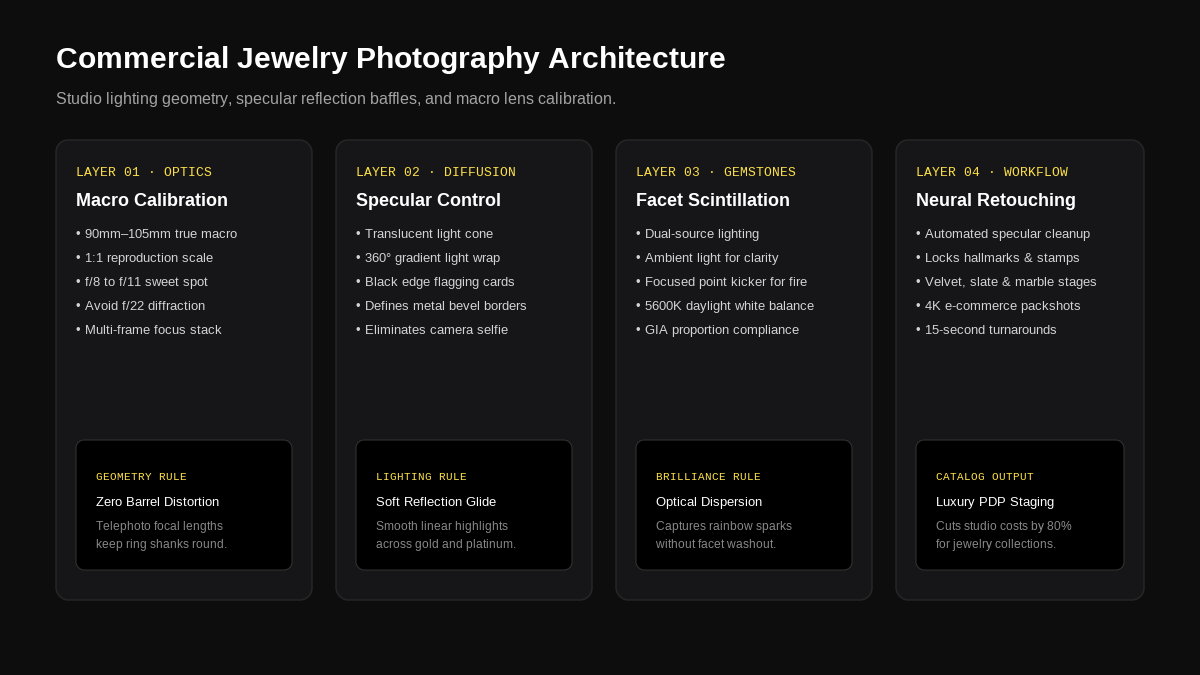
Commercial jewelry photography: lighting geometry, specular reflection baffles, and macro lens calibration.
The four pillars of commercial jewelry photography
To achieve razor-sharp, catalog-ready jewelry visuals, professional studios balance four core technical factors:
Swipe sideways to see every column
| Parameter | Studio standard | Commercial impact |
|---|---|---|
| Optics | 90mm to 105mm dedicated macro lens | 1:1 true reproduction ratio; prevents barrel distortion on ring bands. |
| Aperture | f/8 to f/11 (or focus stacked) | Balances optical sharpness while avoiding diffraction softening past f/16. |
| Diffusion | Double-baffled softboxes or diffusion cones | Eliminates harsh pinpoint reflections; produces smooth gradient gleams. |
| Color Temperature | 5500K to 5600K daylight-balanced CRI 95+ | Preserves authentic 18K yellow gold, rose gold, and platinum alloy tones. |
For high-volume DTC and marketplace catalogs, utilizing a specialized jewelry product photography pipeline eliminates the need for expensive focus-stacking hardware by synthesizing clean macro depth in software.
Lighting setups: controlling specular metal reflections
The biggest mistake in DIY jewelry photography is pointing a bare flash or standard studio light directly at a polished ring or bracelet. Highly reflective metals require continuous, highly diffused wrap-around illumination.
1. The Light Cone / Diffusion Cylinder Technique
A translucent frosted diffusion cone or cylinder placed around the jewelry item creates a seamless 360-degree light wrap. Soft continuous LED panels placed on the left and right illuminate the exterior of the cone, projecting silky, uninterrupted light gradients onto curved ring shanks.
2. Black and White Flagging Cards
Because mirrors only show what is in front of them, bare diffused light can make metal look like dull, milky plastic. Professional photographers place narrow black cardboard strips (black flags) just outside the camera frame to introduce deliberate, crisp dark reflections along the bevels. This contrast defines the physical edges and gives precious metals their distinctive luxury luster.
Camera settings, macro lenses & focus stacking
Jewelry is small, meaning camera lenses must focus at extremely close distances. At high magnification, depth of field shrinks to mere millimeters—often leaving the front claw sharp while the center diamond and rear shank fall completely out of focus.
Overcoming Shallow Depth of Field
- Avoid extreme apertures like f/22 or f/32: While smaller apertures theoretically widen depth of field, optical diffraction degrades fine gemstone facet contrast and softens hallmarks.
- Shoot at the lens sweet spot (f/8 or f/11): Take multiple exposures shifting focus slightly from the front prongs to the rear band, then merge them in software using focus stacking.
Material-specific photography rules
Different precious metals and stones respond completely differently to studio light:
Yellow Gold & Rose Gold
Gold alloys are warm. Ensure your custom white balance is locked at 5600K so 14K yellow gold does not take on a greenish tint and rose gold retains its subtle copper undertones.
Diamonds & Faceted Gemstones
Faceted diamonds need two distinct types of light simultaneously:
- Diffused ambient light to reveal the stone's body color, clarity, and table facet geometry.
- One pinpoint specular kicker (a small fiber-optic or focused LED penlight) to ignite the internal optical dispersion (scintillation and fire).
Review authoritative GIA diamond cut standards to understand how light symmetry and facet proportion influence gemstone brilliance.
Accelerating production with neural macro workflows
Traditional jewelry photography shoots cost upwards of $2,500 per collection, requiring dedicated macro rigs, ultrasonic cleaners, white-glove staging, and hours of tedious Photoshop pen-tool cleanup.
ProductVisualAI's specialized jewelry product photography studio solves these production bottlenecks directly from single raw phone photos:
- Automatically strips out unsightly tripod reflections and camera lens reflections from mirror-polished metal bands.
- Accurately enhances diamond facet fire and stone scintillation without hallucinating artificial gems.
- Locks engraved karat stamps and hallmark typography so listings pass marketplace authenticity guidelines.
- Provides instant luxury secondary staging on deep black velvet, slate slabs, and Italian marble surfaces.
Pair your secondary macro frames with compliant product photography for amazon white mains to build an end-to-end luxury listing pack that converts browsing shoppers into confident buyers.